
FUE is a graft-harvesting method. Small circular incisions are used to remove individual follicular units, usually from the back and sides of the scalp. It can be combined with different implantation approaches, including DHI.
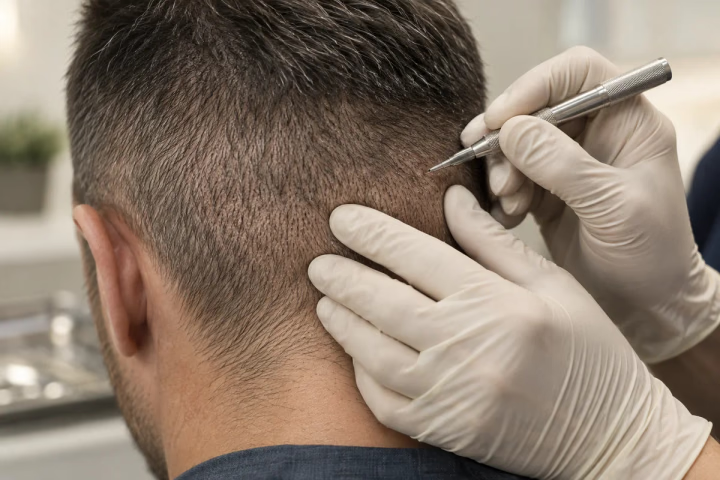
Your donor area is a limited resource.
A responsible proposal balances coverage with the hair that needs to remain in the donor area. Request an explanation of the proposed graft count, donor distribution and how the plan accounts for future hair loss.
FUE is not scar-free.
The extraction sites leave small scars. Their visibility varies with healing, extraction pattern, hair characteristics and haircut length. Claims of “no scars” or unlimited extraction are not a useful basis for a decision.
What should your consultation establish?
- The likely cause and pattern of your hair loss.
- Whether the donor area can support the intended coverage.
- The extraction and implantation methods proposed for you.
- Who performs each stage and who is responsible for medical care.
- The aftercare, risks and longer-term plan for your existing hair.
How long does growth take?
Transplanted hairs commonly shed in the early weeks. New growth appears gradually over the following months; the NHS describes full results as taking around 10–18 months. Your team will explain what to expect for your case.
A graft count is not a hair count.
A follicular unit is a natural grouping that typically contains one to four hairs. A proposal for a given number of grafts therefore does not describe the same number of individual hairs. Hair thickness, curl and the contrast between hair and scalp also influence how coverage appears. Ask for an explanation of the proposed distribution, rather than judging a plan by its largest number.
Agree the coverage you are planning for.
Koç Hair Center describes assessment and hairline planning before donor collection and implantation. Use that discussion to identify which areas matter most to you and how the available grafts would be allocated. Ask the team to explain the intended hairline and coverage on a marked photograph or during your assessment.
Bring information about earlier hair procedures. Your free consultation should help you understand the proposal and the questions that still need a clinical assessment.
Your questions, answered.
What is a FUE hair transplant?
FUE stands for follicular unit excision. Small punches remove individual follicular units from a suitable donor area. It describes harvesting, while placement is a separate stage. Ask how those grafts will be used to address your hair loss.
Does FUE leave scars?
Yes. FUE leaves small scars at the extraction sites, rather than the single line associated with strip harvesting. Visibility depends on factors including the extraction pattern, healing and how short you wear your hair. Ask to see donor-area examples as well as photographs of the transplanted hairline.
Does the donor area for FUE grow back?
A follicle that has been removed does not regenerate in its original donor position. Hair left around the extraction sites can provide coverage, but the donor supply is reduced. This is why planning the number and distribution of extractions matters for both appearance and future options.
How many FUE grafts will I need?
There is no reliable universal number for a hairline, crown or stage of hair loss. The proposal needs to consider the area to cover, available donor hair and your hair characteristics. Ask what the recommended graft allocation is intended to achieve and what limitations remain.
Is one FUE graft the same as one hair?
No. A follicular unit typically contains one to four hairs. Graft count and hair count are different measures. Ask how grafts will be distributed across the treated areas, rather than judging a proposal by its largest quoted number.
Can FUE give everyone the same density?
No. Donor supply and hair characteristics differ between people. The area needing coverage must be considered alongside what can reasonably be taken from the donor region. Ask the team to explain the expected appearance for your hair, instead of comparing graft numbers with another patient’s plan.
How long does FUE recovery take?
Recovery depends on the extent of the procedure and how you heal. Returning to light daily activities is different from returning to strenuous exercise or judging hair growth. Follow the treating team’s instructions and ask for a practical schedule for work, sport and review appointments.
Does FUE hair transplantation hurt afterwards?
Soreness, tightness, itching or throbbing can occur after transplantation. Ask the team what discomfort to expect and how it should be managed in your case. Contact your treating clinician about symptoms that worry you instead of relying on a generic online recovery timetable.